OUR APRIL 26, 2012
SPRING LUNCHEON MEETING & PROGRAM
Program & Venue Details < (CLICK HERE)
Please note the venue is - Denny's Restaurant, #11 - 1804 - 19th Street NE, Calgary, AB
It is that time again to get together for fun and socializing at our upcoming Spring luncheon meeting, scheduled for 10:00 AM, April 26, 2012. The venue is at Denny's Restaurant - #11 - 1804 - 19th Street NE, Calgary, AB.
Our luncheon will be offered from the Denny's Restaurant menu. A seniors menu is also available. You will only pay for what you order from the menu.
Please remember, spouses and guests are most welcome and encouraged to join us for our meeting and lunch. We try to make our programs exciting for the ladies as well the gents.
PRESENTATION
(A Video Presentation Entitled)
VOICE OF VICTORY
During the war years communications was vital to keep ahead of enemy forces. The US Military contracted the Hallicrafters company to manufacturer, from beginning to end, a system for the army to keep in touch with everyone on the battlefield - from ground to air.
The HT-4 Hallicrafters transmitter (circa 1938), was widely used in the amateur radio community. It was soon to be known as the BC-610 and later the Military version - know as the SCR-299.
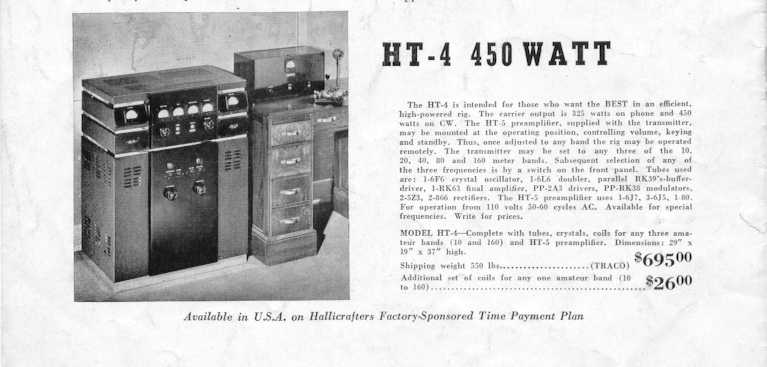
Amateur Model HT-4 to BC-610 to SCR-299
About 50" High, 600lbs. Production Year 1938-45.
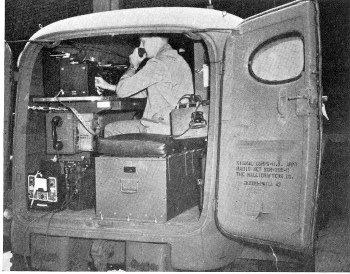
Early Version Of SCR-299
And so the story goes....
Hallicrafters - Young Engineer does good…
William (Bill) J. Halligan, founder of Hallicrafters, was born in Boston, Massachusetts in 1899. He got his first ham license as a teenager. Even at that age he considered himself a radio experimenter and built an early spark-gap transmitter. Bill's first job, at age 16, was as a wireless operator on excursion ships between Boston and other coastal cities.
When World War I began, he put his skills to good use by serving his country as a wireless radio operator on the battleship Illinois. After the war was over he attended engineering school at Tufts College and West Point, but left when he married in 1922. He took a job as a newspaper reporter, and then left journalism in 1924 to sell radio parts. In 1928 he decided to start his own company, and moved to Chicago, Illinois. This salesman had ideas for improving the short-wave radios that he had been selling. It was a brave venture, with almost no capital, manufacturing license problems and then the depression, but in 1933 Bill founded the Hallicrafters company that made him a legend.
Hallicrafters built handcrafted receivers with state-of-the-art features at an affordable price. By 1938, Hallicrafters was considered one of the "Big Three" manufacturers of amateur receivers (Hallicrafters, National and Hammarlund) and was selling not only in the U.S. but 89 other countries. He had 23 different models of transceivers and was ready to start producing transmitters, beginning with the HT-1. Instead of putting a lot into expensive cabinets, Halligan believed in providing every nickel's worth into the performance of the chassis and the latest in circuit design. His greatest salesmen were those who used his equipment and praised it to others over the air.
When World War II began, there was a tremendous shortage of military radio equipment. Hallicrafters geared up for wartime production, and perhaps the best known new design is the HT-4 (BC-610) which was used extensively during the war. After the war, focus was again on consumer electronics, including radio phonographs, AM/FM receivers, clock radios and televisions.
The 1950s were the most successful years for the company. In 1952 Hallicrafters' main plant in Chicago housed general offices and the factory and was a block long. In addition to the main plant was a 3-story building of 72,000 square feet two blocks away, a 1-story coil plant of 12,000 square feet on Chicago's north side, and 150,000 square feet of production and storage space in three other buildings within a five-mail radius of the main plant. The company employed 2,500 people. Many of the radio products became classics, e.g. the HT-32 and the SX 101. Much of this equipment is still used today and collected by nostalgia buffs.
In 1966 Northrop Corporation bought Hallicrafters and moved the company to a new plant in Rolling Meadows, Illinois. The company's main function was to produce para-military equipment and electronic countermeasures systems. Hallicrafters produced a few ham radios through 1972 and a few accessories through 1974.
From 1933 until the company was sold to Northrop, Bill Halligan, W9AC, always supported the ham radio hobby. He died on July 14th, 1992 at the age of 93.
Don't miss this exciting social meeting. Bring a guest, bring some questions and, let's enjoy this meeting of the QCWA Chapter 151 in Calgary!
So be sure to bring your significant other and join us for this exciting luncheon presentation.
|
|
Home :|: Reasons to Join :|: Information On How To Join :|: Membership Applications :|: Chapter Executive Membership List :|: Silent Keys :|: Charter Members :|: Other Links :|: Archived 'QCWA Wild Rose Repeater' Archived 'Chapter Minutes' :|: Archived 'Chapter Journal Reports' :|: Scholarships :|: Member Profiles :|:
|
|
